Election 2026
Midterm Blue Tsunami’s Impacts On Construction Industry Unclear
By JOHN JORDAN
WASHINGTON—Analysts are beginning to theorize what impact the Democratic victory, characterized by some as a “blue tsunami” in the recent midterm election, will have on the transportation and building sectors going forward. Most are hopeful that Congress and the Trump Administration will collaborate on a bipartisan effort to increase transportation infrastructure spending in the new year.
Reasons for the Democratic rout centered on inflation, the high cost of living, the Iran war, tariffs, corruption, opposition to data centers and declining support for President Trump, according to multiple polls.
At press time, construction industry advocacy organizations remained focused on pressing Congress to pass extensions of funding for federal highway and transit programs, which are set to expire on Dec. 11.
While the final count is still in doubt, Democrats easily won majorities in both the House and Senate in the 2026 midterm election. As of Nov. 5, Democrats held a 54-44 majority in the Senate and a 247-153 advantage over Republicans in the House. While Democrats took control of both chambers, the party fell short of a filibuster-proof majority of 60 votes and a veto-proof majority of 67 votes in the Senate, as well as the 290 votes needed for a veto-proof majority in the House. Therefore, Congress must move forward in a bipartisan manner to enact meaningful legislation, both during the lame-duck session for the remainder of 2026 and going forward once the new session of Congress convenes in January 2027.
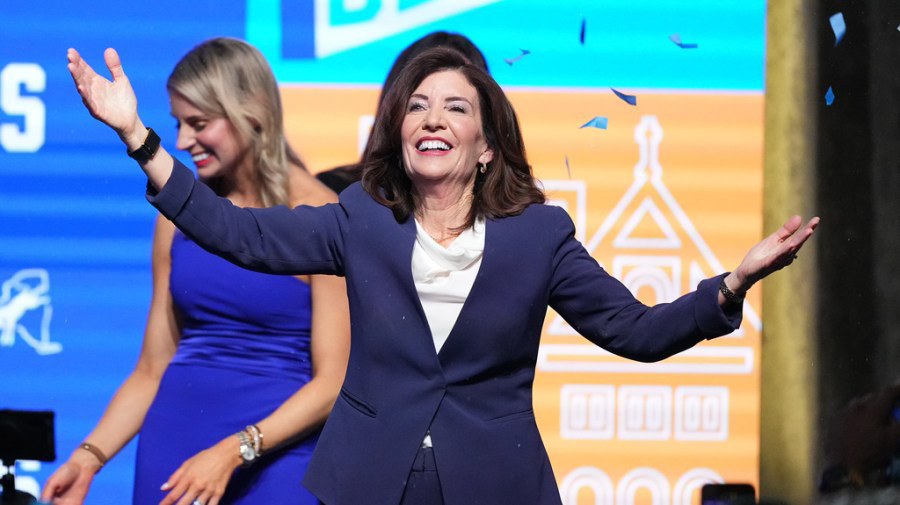
Democrats also made significant gains in New York State, with Gov. Kathy Hochul winning re-election over GOP challenger Bruce Blakeman.
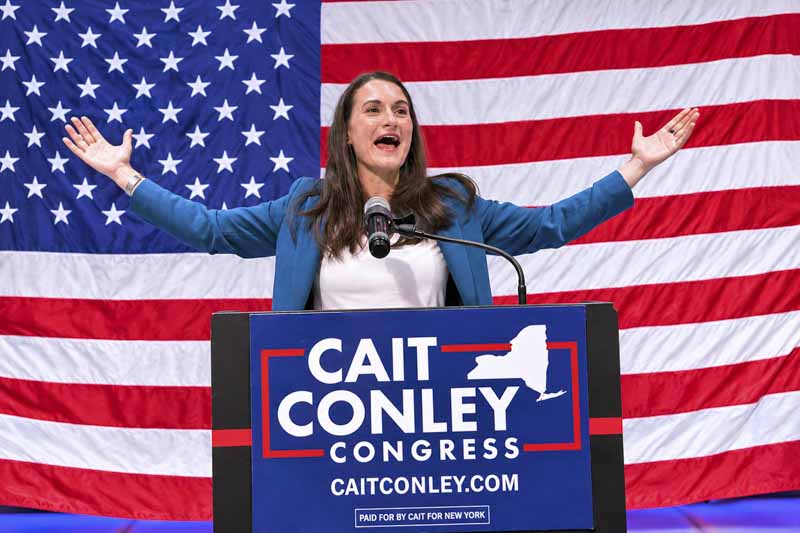
At press time, Democrats held a supermajority of 42-13 in the Senate and 101-36 in the Assembly over Republicans. Another high-profile Democratic victory was that of Cait Conley, who defeated Republican incumbent Congressman Mike Lawler for the 17th District House seat.
Analysts are taking a wait-and-see approach to determining what impact the midterm elections will have on the transportation construction sector in New York State. At press time, the industry was awaiting the release of the new Five-Year Capital Plan by the New York State Department of Transportation. State transportation funding, particularly for large capital projects such as the Gateway Tunnel Project and the Second Avenue Subway, has been impacted by funding delays and disputes with the Trump Administration.
Since some state infrastructure projects rely on federal funding, the contentious relationship between the Trump Administration and New York State has made capital program planning problematic.
Dave Bauer, president and chief executive officer of the American Road and Transportation Builders Association (ARTBA), penned a memo to the Board of Directors and Chapter Executives outlining his views on the impact the midterm election results will have on the transportation industry. The Construction Industry Council of Westchester & Hudson Valley, Inc. is a state chapter affiliate of ARTBA.
He noted that ARTBA’s top priority during the lame-duck session remains reversing the $13.5 billion in cuts to highway and transit programs included in the extension that expires on Dec. 11.
The incoming Congress will feature at least 18 new senators and up to 100 new members of the House, making this one of the largest freshman classes in recent history. ARTBA will be meeting with all of their offices after they are sworn in on Jan. 3, 2027, Mr. Bauer stated.
He said these newly elected officials are already hearing from countless stakeholders, some with competing priorities. “Your engagement with them at home and in Washington, D.C., is essential to ensure they understand how the pending highway and transit program reauthorization impacts communities and how continued delays impact safety, mobility and economic growth,” he stated.
Despite significant Democratic wins, bipartisanship will still be required to pass legislation. Senate Democrats will not meet their chamber’s 60-vote threshold to overcome a filibuster. Mr. Bauer noted that the Senate Environment and Public Works Committee has a history of reaching consensus on reauthorization legislation. “This underscores ARTBA’s ongoing commitment to bipartisan policies and political activities to advance industry priorities,” he noted.
Several members of Congress integral to the passage of the 2021 infrastructure law are leaving Congress, including Republican Sens. Bill Cassidy (R-LA), Mitch McConnell (R-KY) and Thom Tillis (R-NC), as well as Republican Reps. Don Bacon (R-NE), Brian Fitzpatrick (R-PA) and Jeff Van Drew (R-NJ).
He reported that Rep. Rick Larsen (D-WA), the likely next chair of the House Transportation & Infrastructure Committee, has pledged to continue working in a bipartisan manner. He plans to use the “BUILD America 250 Act,” which advanced through committee nearly unanimously, as a foundation for new legislation when the process starts anew in January.
“It remains to be seen if President Donald Trump and congressional Democrats will seek common ground on transportation issues, or if the President will embrace his veto authority,” Mr. Bauer stated.
The Transportation Construction Coalition echoed ARTBA’s call for restoring federal transportation funding and enacting a fully funded, multi-year surface transportation reauthorization during the lame-duck session. The TCC warned Congress that the consequences of inaction would affect the programs states and communities rely on to repair aging bridges, ease highway congestion and deliver critical safety improvements.
“When Congress returns to Washington, lawmakers have an urgent responsibility before the Dec. 11 deadline: restore advance appropriations programs and pass a multi-year transportation reauthorization bill. The current funding lapse puts critical infrastructure upgrades and repairs at risk. States and communities need funding and certainty to plan projects, keep workers on the job and deliver safer, more reliable roads, bridges and transit systems,” the TCC stated.
Advance appropriations for Division J programs were not included in the September continuing resolution passed by Congress, resulting in several federal programs losing dedicated funding on Oct. 1.
The programs no longer supported under the current extension include:
- The Bridge Formula Program provides $27.5 billion to help states repair, rehabilitate and replace bridges. ARTBA reports that more than 220,000 bridges, roughly 35% of all U.S. bridges, require major repair work or replacement.
- The Safe Streets and Roads for All program has provided $3.9 billion in federal funding to more than 2,000 communities across all 50 states and Puerto Rico, saving lives and reducing serious traffic-related injuries.
- The National Infrastructure Project Assistance Program (MEGA) has made $1.8 billion available to support highway, bridge, freight, port, passenger rail and public transportation projects nationwide.
Published: November 12, 2026.