NYCDEP Updates CIC Gathering on $2.5B in Planned Hudson Valley Tunnel Projects
By RYAN CAPALBO
WHITE PLAINS, NY—Approximately $2.5 billion in tunneling projects in the Hudson Valley will be key to the future of the nation’s largest municipal water supply. That is what Adam Bosch, executive director for strategic operations and research at the PLY New York City Water Supply, told the Construction Industry Council when he provided the keynote address at the council’s 2026 Fall Membership Meeting at the Sonesta Hotel in White Plains.
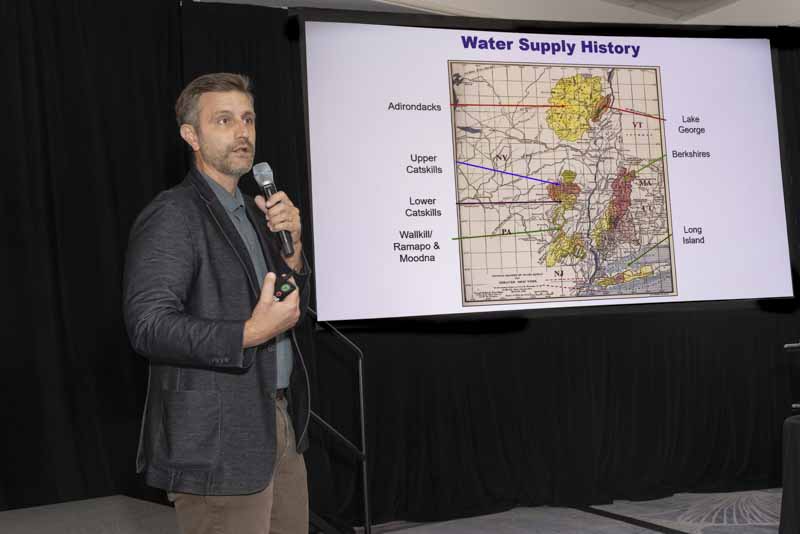
After giving a brief history of the water systems that provide New York City and the surrounding Hudson Valley with their drinking water, Bosch turned his attention to detailing two tunneling projects that are currently under construction by the New York City Department of Environmental Protection (NYCDEP) and its contractors.
The first is the Kensico-Eastview Connection (KEC), a brand-new tunnel designed to deliver water from Kensico Reservoir to the Catskill-Delaware Ultraviolet Treatment Facility in Eastview.
“This project is key to the resilience of the City’s water supply,” Mr. Bosch told the attendees. “This will provide us with another aqueduct to deliver water between these critical locations in the system. The new tunnel was also designed with enough capacity to meet the future growth demands of New York City and Westchester County, and it will also allow us to shut down other parts of our system for inspection and rehabilitation.”
The tunnel will be about 2 miles long and 27 feet in diameter when it is completed in the early 2030s. The tunnel will be excavated with a tunnel boring machine that is currently being built. It is expected to be delivered to the site sometime in 2027.
On the Kensico site, several new buildings will need to be constructed, including a new screen chamber and an electrical building. Work will also be done to rehabilitate an existing intake structure at the reservoir. These buildings will be used to move, screen, and treat the water as it goes into the new tunnel. Three shafts will also be constructed via blasting to gain access to the subsurface and build the various tunnels and interconnections that will move water through the facilities.
Blasting is currently happening at the Kensico site to build one of the shafts and the foundation for the large screen chamber. The entire project will be finished in the mid-2030s, and the finished tunnel will have a capacity of 2.65 billion gallons of water.
NYCDEP is also working to complete a second tunnel project that began more than a decade ago. Work will soon restart to finish the Delaware Aqueduct Bypass Tunnel, a new tunnel under the Hudson River between Newburgh and Wappinger that will move water around a leaking section of the Delaware Aqueduct. Once the bypass tunnel is completed, the leaking section of the existing aqueduct will be plugged and taken out of service forever.
Initially put into service in 1944 in an emergency to provide additional water to support World War II efforts in New York City, the Delaware Aqueduct today conveys about 50% of the City’s drinking water. At 85 miles long, the Delaware Aqueduct is the longest continuous tunnel in the world.
The leak in the Delaware Aqueduct was first discovered in the 1990s when an electrical utility worker raised concerns about water bubbling up in the Hudson River during low tide. After extensive testing and investigations, hairline cracks were discovered in the aqueduct. Due to the relatively high demand for water in New York City at the time, as well as a lack of viable alternative water resources, the City was unable to begin work on fixing this issue until the mid-2010s. Since the 1990s, the City has grown by 1.5 million people, but its water demand has decreased by 35% thanks to modern metering, low-flow fixtures, and other water conservation efforts. That means the City now has enough water in other parts of its supply to go ahead with what Bosch called “the biggest bypass surgery in the history of America.”
To create the bypass, NYCDEP built a new tunnel parallel to the leaking section of the original Delaware Aqueduct. That part of the project was completed around 2021 after years of constructing shafts and drilling the tunnel. In 2023, exercises were conducted to prepare to pump the Delaware Aqueduct dry for the first time since the 1950s.
Everything was moving smoothly until NYCDEP shut down the aqueduct in 2024 to make the final connection. The region was then hit with a flash drought that required the City to bail out of the project to restore the flow of drinking water through the aqueduct to meet the needs of its 9.5 million customers.
The contract to finish the bypass tunnel then expired, which required NYCDEP to begin a new procurement cycle to bid the project and select a contractor to carry out its final stages. There is no current timeline for completing the project, although Bosch said that NYCDEP is aiming to complete the critical infrastructure work in the coming years.
Published: November 12, 2026.