Major Work Begins on Largest Subway Signal, Track Replacement Project in MTA History
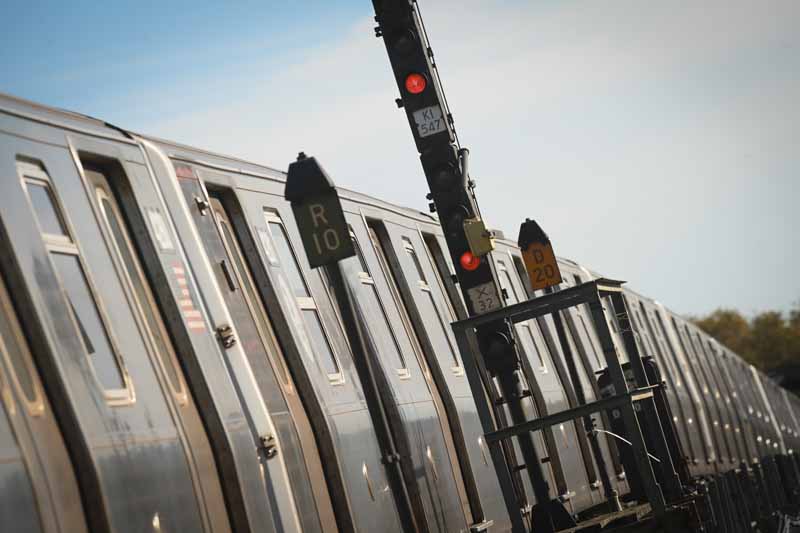
NEW YORK — Work began late last month on the largest signal and track replacement project in the history of the Metropolitan Transportation Authority. The $1.9 billion investment, made possible with funds from congestion pricing, will modernize A and C service in Brooklyn and Queens, replacing antiquated, 1930s-era signals with Communications-Based Train Control (CBTC). The modern signal system allows trains to safely run faster and closer together, facilitating more frequent and reliable subway service.
The contract for the project was awarded to L.K. Comstock & Railworks of East Farmingdale, NY, in December 2025. Completion is expected in the second quarter of 2032.
“Congestion pricing keeps delivering wins for New Yorkers,” Gov. Kathy Hochul said. “Upgrading nearly 100-year-old signals does more than just modernize infrastructure that is long overdue — it is a critical part of our plan to run better and more frequent subway service, shortening waits and slashing delays. When this project is done, hundreds of thousands of A and C train riders will benefit from the world-class service on new, modern trains that New Yorkers deserve.”
The project spans 42 track miles along the Fulton and Liberty lines and will replace the oldest remaining signal equipment in the subway system. The work will extend from High St on the A and C lines to Ozone Park–Lefferts Blvd on the A line, covering 23 stations that serve 350,000 riders each weekday. The project corridor provides connections to seven other subway lines, 36 bus routes and the Long Island Rail Road. Across their full routes, the A and C lines serve 750,000 riders each weekday.
The work builds on other CBTC investments serving A and C riders along Eighth Avenue between 59 St in Manhattan and High St in Brooklyn. Modernizing signals across nearly 85 miles of the subway system is made possible with funds from congestion pricing. Gov. Hochul’s successful funding of the MTA’s 2025–2029 Capital Plan provides an additional $5.4 billion to modernize signals across more than 75 miles on the Broadway N/Q/R/W, Liberty Avenue A, Rockaway A/S and Nassau Street J/Z lines.
MTA Chair and CEO Janno Lieber said, “Signal issues are the number one cause of subway delays — no surprise considering the ancient relics we’ve been using to direct train traffic. Thanks to this almost $2 billion project — the largest of its kind in MTA history — we are going to be able to run more A and C trains faster, safer and more reliably than ever before.”
Modern Signals Deliver More Reliable Service
Signal issues are the leading cause of subway delays. Much of the system still relies on aging equipment with components that are no longer commercially manufactured, making maintenance increasingly difficult and expensive. The existing signal system divides tracks into fixed sections and identifies whether a train occupies each section. CBTC provides a more precise picture of train locations and speeds, allowing trains to safely operate closer together and supporting more frequent service. The modern equipment is also less expensive and easier to maintain.
CBTC is currently operating across the full 7 and L lines, as well as portions of the E, F, M and R routes on the Queens Boulevard and Culver lines. Following signal modernization, on-time performance on the 7 line jumped from 68% to 91%. On the E line in Queens, train speeds increased by approximately 10% following CBTC activation.
For the Fulton-Liberty signal modernization project, the MTA will use an approach that has been shown to reduce signal modernization costs per mile by 33% compared with the average for prior CBTC projects. The MTA achieved this by shifting to a design-build contracting model that transfers much of the project risk to contractors.
Additionally, the MTA’s new strategy for these projects focuses solely on installing state-of-the-art Communications-Based Train Control technology, foregoing the costly maintenance of legacy signaling during the transition, reducing the need for expensive equipment along the tracks and maximizing scheduled service outages.
The first phase of work will focus on replacing aging switches and more than 250 feet of specialized track between 104 St and 99 St in Queens. The project will also include infrastructure to support future cell service for riders and work to keep existing infrastructure in a state of good repair.
Published: November 12, 2026.