
WTC 25 Years Later: New Dynamics and its Lessons Are Driving the Nation’s Future
TARRYTOWN, NY—The construction industry that rebuilt the original World Trade Center is very different from the one that rebuilt the One WTC complex and Freedom Tower in Lower Manhattan. So much of American life has changed in the past quarter of a century in terms of human behavior and the building/rebuilding of the physical world.
With a third of the U.S. population born after 9/11, we live in a country in which today’s workforce views the job differently, explained Joseph Armentano, chairman and CEO of Paraco Gas Corporation. “Many people do not know what countries were involved in the attacks,” which he labeled as a decisive moment in American history. His company traces its roots to the late 1970s and has experienced the evolution of the workplace through 9/11, the Great Recession of 2008-2009, and impacts of the COVID-19 pandemic.
“The employer-employee relationships transformed from those decades earlier, once based heavily on loyalty, to a workplace driven by transactional and career opportunities,” he noted. “Every generation thinks that next generation is not as good as we are. But what we find out is it’s different.”
The challenge, he said, is to manage a new generation of workers in a workplace and economy that has dramatically changed in so many ways. (His company has grown through acquisition and expansion to now employ some 480 people covering six states in the Northeast.)
“Employees today look for balance, change and are less loyal to employers,” he stressed. “Employers need to recognize this change and be more flexible, something that does not come easy for the leaders of the generations before 9/11.”
Key factors driving changes in the construction industry the past 25 years
- Risk Transfer Restructured. It has been underscored by terrorism coverage, which effectively vanished in late 2001 and had to be legislated back with the Terrorism Risk Insurance Act (TRIA) in 2002, according to an industry survey.
- Prequalification and Compliance. The determining question has shifted from “can you build it” to “can you document that you’re allowed to build it.” Getting on a big public job now means responsibility determinations, integrity monitors, SAM registration, apprenticeship-program requirements, DBE/MWBE/SDVOB participation, and mandatory site safety training.
- Project Procurement. Construction delivery has changed. Design-bid-build lost its monopoly to design-build, CM-at-risk, progressive design-build and P3s. (New York State gave DB more authority 2019.)
- Cybersecurity. This has become a construction concern both for firms and for the building systems they install.
- Attacks on Immigration. Forget the Fiscal Cliff, we’re headed over the Labor Cliff. Industry sources project new labor needs at 349,000 new workers in 2026 alone, with another 457,000 in 2027, driven by retirements and reduced immigration. Estimates hold that up to 30% of construction workers are foreign-born, which makes current enforcement policy a direct risk to seeding a future workforce.
- Resilience and carbon. For New York specifically, Superstorm Sandy in 2012 arguably changed design practice as much as 9/11 did. These include flood elevation, relocated switchgear and generators, and ASCE 24 (Flood Resistant Design and Construction), the national standard for minimum requirements for the design and construction of buildings and structures in flood hazard areas.
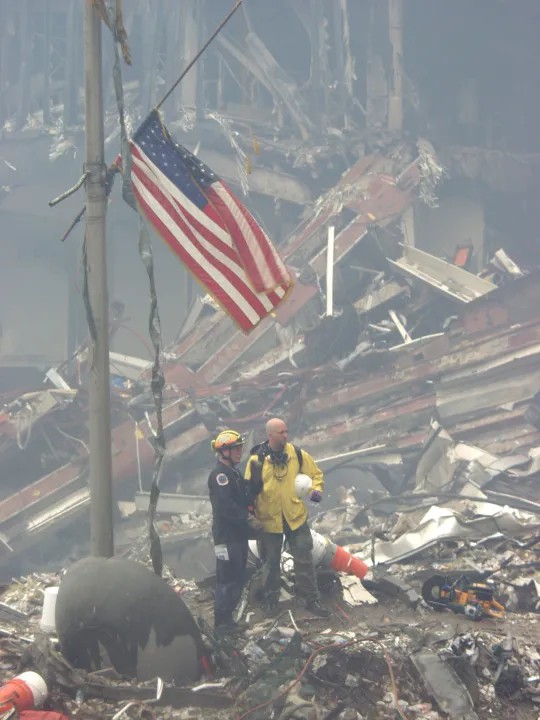
- A Culture of Safety. Safety became its own design discipline with its evolving science, technology and expanded budgets. Now worker health has a long-tail liability. Fall protection, the 2016 silica rule, crane regulation after the 2008 NYC collapses—plus two genuinely new topics: mental health and suicide prevention in the trades, and the health legacy of Ground Zero itself. The WTC Health Program now serves roughly 140,000 members across all 50 states, and FDNY deaths from 9/11-related illness have passed the 343 lost on the day. Much of the recovery work was done by Operating Engineers, Laborers and Iron Workers.
- Geographic separation, not just backup. Redundancy is not just a fire-proof storage box in the basement. Contractors in 2001 kept drawings, submittals, payroll, bonding records and insurance certificates on paper in one office. That’s now cloud-hosted, and often tested and checked, never assumed.
- Redundancy in design. The Governor Mario M. Cuomo Bridge was built as twin spans so that one can carry traffic when the other cannot. The Tappan Zee had no such option, and neither did its users. The same argument runs vertically: after the National Institute of Standards and Technology (NIST) investigation, buildings above 420 feet require an additional exit stairway and all new high-rise stairs are 50% wider, because the North Tower’s three stairwells shared a single core and one impact took all three. Horizontally, the Gateway’s new Hudson River tunnels make the identical case underground, alongside century-old tubes that Superstorm Sandy nearly finished off.
In a sense you could argue that the last 25 years have mostly been about government municipalities, businesses and the construction/design industry learning to ask if there is a shared failure point and where it is most likely to occur—and then paying to remove it.
Compiled and edited by George Drapeau III, with industry reports.
Published: September 17, 2026.