
New York City Update
Interborough Express to Begin This Summer With Focus on Light Rail System Design
NEW YORK—The engineering and design phase of the $5.5-billion Interborough Express (IBX), which is the next step in the development of the transformative transit project, is underway.
On July 30, the MTA Board authorized the selection of a joint venture between Jacobs and HDR as the team that will oversee the design and engineering phase of the IBX. The project is intended to connect historically underserved communities in Brooklyn and Queens to the subway, bus and Long Island Rail Road, and reduce travel times between Brooklyn and Queens. In April, $2.75 billion in funding for the project was approved as part of the historic 2025-2029 MTA Capital Plan.
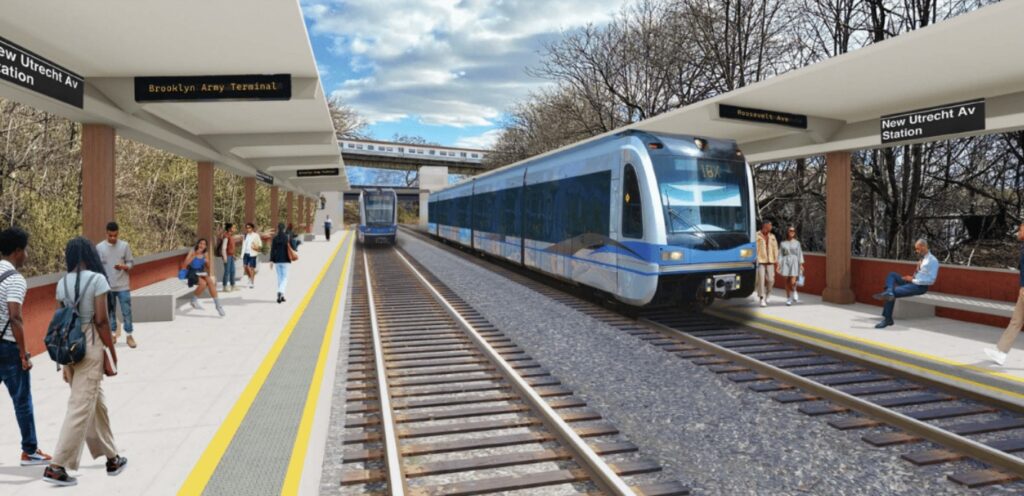
The IBX will be a new transit option for close to 900,000 residents living in neighborhoods along the route, along with 260,000 people who work near the corridor in Brooklyn and Queens. It will create 19 stations and connect with 17 different subway, 50 bus routes and two LIRR stations. The project will be built along an existing, 14-mile freight line owned by the MTA LIRR and CSX Corp. that extends from Sunset Park, Brooklyn, to Jackson Heights, Queens. New York and Atlantic Railway currently operates freight rail on the corridor under a concession agreement on the LIRR branch.
The IBX will be the first new end-to-end rapid transit built entirely within New York City since the IND Crosstown Line, now called the G, fully opened in 1937. IBX stations built in Brooklyn will be the first transit stations built in the city’s most populous borough since the A line extended from Broadway Junction to Euclid Ave in 1948. IBX stations in Queens will be the first new transit stations built since the Archer Avenue extension of the E, J, and Z lines to Jamaica in 1988.
The IBX is the latest major transportation project that Governor Hochul has advanced. In May, Governor Hochul and the Port Authority of New York and New Jersey broke ground on the first phase of the new Midtown Bus Terminal project. In January, Governor Hochul and the MTA commenced the nation’s first-ever congestion pricing program, which has successfully reduced traffic and increased economic activity in Manhattan. In July 2024, Governor Hochul secured a $6.88 billion federal grant agreement for the Gateway Development Commission to proceed with the Hudson Tunnel Project, improving rail service for over 200,000 daily riders.
MTA Chair and CEO Janno Lieber said, “The IBX is a life-changer for millions. It’s about time Brooklyn and Queens residents could move directly between our two most populous boroughs – for jobs, education, recreation and everything else.” He said credit goes to Gov. Hochul and New York’s partners in Albany and Washington for “getting this project off the ground.”
The project design phase will be principally funded through $45 million in New York State’s 2025 budget and the MTA’s 2025-2029 Capital Plan. An additional $15 million was awarded to the MTA by the United States Department of Transportation’s Rebuilding American Infrastructure with Sustainability and Equity (RAISE) grant, which will fund a corridor assessment in support of the design phase. USDOT has also provided $1 million to fund innovative finance expert services for the project. The total estimated cost of the IBX project is $5.5 billion, with 50% of the total funding for the project in the MTA’s 2025-2029 Capital Plan.
3,000-Unit Housing Plan for Queens On Former Site of Flushing Airport
NEW YORK—New York City Mayor Eric Adams and New York City Economic Development Corporation President and CEO Andrew Kimball unveiled a sweeping proposal to build approximately 3,000 homes and 60 acres of public space on the site of the former Flushing Airport in College Point, Queens.
The development—led by New York City-based firms Cirrus Workforce Housing and LCOR Inc.—is projected to generate $3.2 billion in economic activity over the next 30 years, creating more than 1,300 union construction jobS and 530 permanent careers.
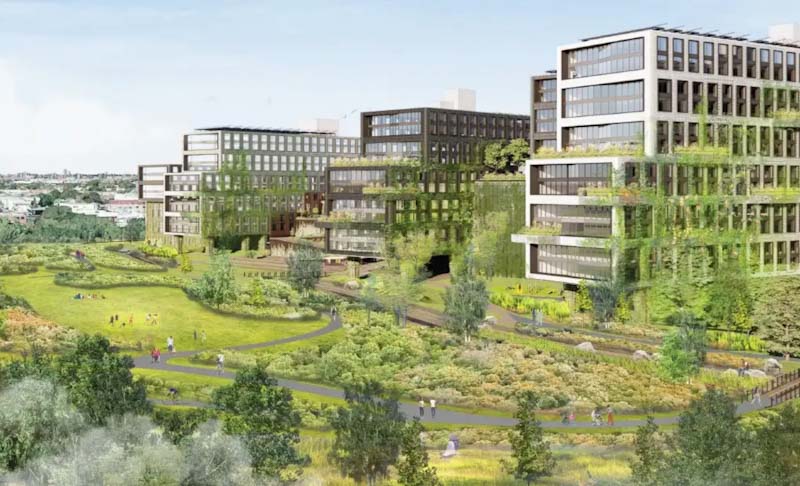
Cirrus-LCOR’s proposal also includes sustainable design elements and high-quality, park-like landscaping to integrate the buildings into the surrounding wetlands environment. Following the completion of a successful Uniform Land Use Review Procedure (ULURP) and a robust environmental review, construction is expected to begin in 2028.
After Mayor Adams issued an executive order last year requiring city agencies to review their portfolios and identify potential sites for new housing, NYCEDC led a competitive request-for-proposals process to identify a developer for the former Flushing Airport. As a result of the partnership established in March 2024 between Cirrus Workforce Housing, Mayor Adams, and the New York City Building Trades to develop workforce housing on public lands using union labor, this project will be built by Building Trades members using union pension fund dollars.
Along with proposals to build thousands of new homes on city-owned sites like 100 Gold Street and Gansevoort Square, five neighborhood plans to create jobs and new housing across the city, and the first citywide housing zoning reform in 60 years, the plan for Flushing Airport will help New York City reach Mayor Adams’ moonshot goal of creating 500,000 new homes by 2032, city officials stated.
“For too many decades, this valuable land has sat vacant, but our administration said it was time to change that. We issued a landmark executive order to build housing on city-owned sites like this one and now we are excited to announce we will create around 3,000 new homes at the site of the former Flushing Airport,” said Mayor Adams.
“The redevelopment of the former Flushing Airport will deliver thousands of affordable and accessible homes that are financed by, built by, and lived in by union workers, as a result of our partnership with Cirrus and Mayor Adams,” said Gary LaBarbera, president, Building and Construction Trades Council of Greater New York. “Thanks to this generational program, this project and others like it will continue to reinforce labor’s historic role in boosting the middle class, generating family-sustaining careers, and providing our communities with economic stimulus.”
The former Flushing Airport has not been active since the airport was decommissioned in 1984 and has largely reverted to nature. Cirrus-LCOR’s proposal will utilize sustainable design elements, including a commitment to explore the use of mass timber construction and high-quality park-like landscaping that is accessible to the public and sensitively integrates the buildings into a modern wetlands environment with nature walks, sitting areas, rambles, natural open space vistas, and wildlife habitat. Lastly, Cirrus and LCOR have committed to build and operate the development with 100% union labor.
Published: August 15, 2025.